
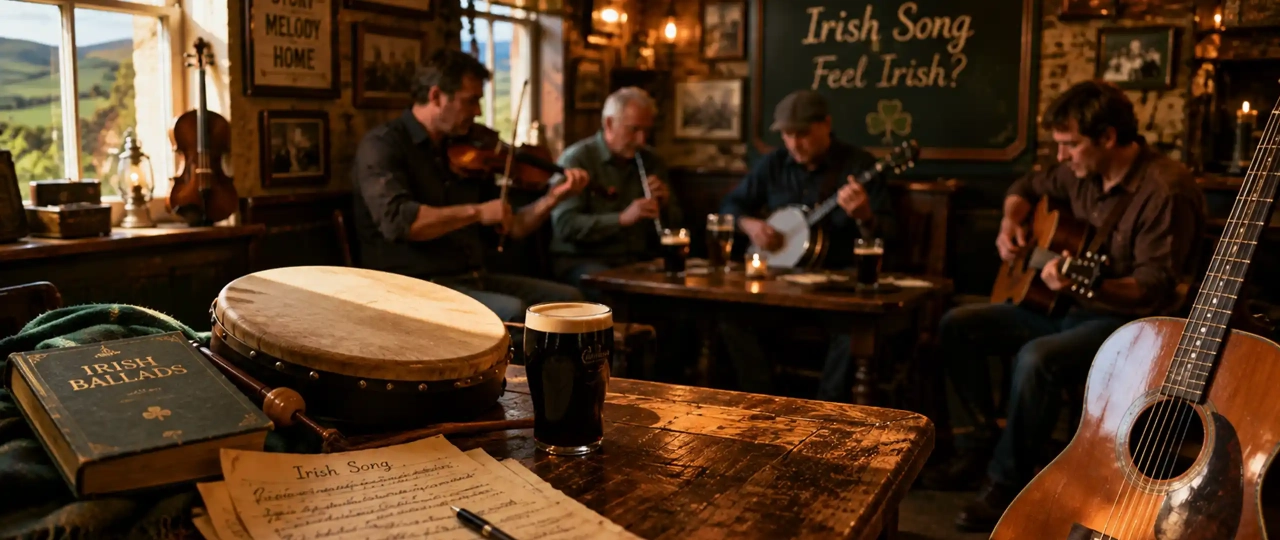
There is something about an Irish song that can be difficult to explain. You can sometimes hear just a few bars of a melody and immediately think, “That sounds Irish.”
But what creates that feeling? Is it the instruments? The melody? The words? The subject of the song? Or is it something deeper? After a lifetime spent listening to, playing, writing and recording music, I think it is probably a combination of all of these things.
But I also believe there is something about the feeling of an Irish song that cannot always be explained.
It's Often About the Story
One of the great strengths of Irish music is storytelling. Irish songs have traditionally told stories about people, places, love, loss, emigration, home, hardship, friendship and the passing of time.
Many of the old ballads weren't simply songs to be listened to. They were stories that were remembered and passed from one generation to another. That tradition is still alive today.
A good Irish song can introduce you to a person you've never met, take you to a place you've never visited or make you feel homesick for somewhere you haven't seen in years. That is quite a remarkable thing for a song to do.
The Melody Matters
There is also something distinctive about many Irish melodies.
You often find melodies that have a natural rise and fall, with phrases that almost seem to carry the listener along with them.
Traditional Irish music has given us an enormous musical vocabulary of jigs, reels, slow airs and ballad melodies. But even modern Irish songs often carry some influence of that musical tradition.
Sometimes it is obvious. Sometimes it is much more subtle. A songwriter may not deliberately try to write an “Irish” melody at all, yet something in the phrasing or movement of the tune gives it that unmistakable character.
The Instruments Help
Of course, instruments play their part. The fiddle, tin whistle, flute, accordion, banjo, bodhrán, mandolin, bouzouki and traditional guitar sounds are strongly associated with Irish music.
But Irish music isn't defined by having a particular collection of instruments. I've heard Irish songs performed with nothing more than a voice and guitar that sounded completely Irish.
I've also heard large arrangements using modern instruments that still retained a strong Irish identity. The instruments can provide the colour, but they don't create the identity on their own.
The Voice Is Important
I think the voice is one of the most important ingredients. There is often a directness in the way an Irish song is sung. It doesn't necessarily need a technically perfect voice.
In fact, sometimes a little roughness or character in a voice makes a song more convincing. The listener needs to believe the singer.
A great Irish ballad can be sung very simply, almost as though somebody is telling you a story across a table. That intimacy is powerful.
In fact, sometimes a little roughness or character in a voice makes a song more convincing. The listener needs to believe the singer.
A great Irish ballad can be sung very simply, almost as though somebody is telling you a story across a table. That intimacy is powerful.
Home, Leaving and Coming Back
There are certain subjects that appear again and again in Irish songs. Home is one of them. So is leaving home. Ireland has a long history of emigration, and songs about leaving family, friends and familiar places have a particular emotional weight.
There are songs about people sailing away, songs about returning home, songs about missing Ireland and songs about places remembered from childhood. These themes aren't uniquely Irish, of course.
But they have become deeply woven into Irish musical culture. Perhaps that's why an Irish emigrant living thousands of miles away can hear an old Irish song and suddenly feel as though they are back in the village where they grew up.
The Importance of Simplicity
Another thing I've learned over many years of recording is that an Irish song doesn't necessarily need a complicated arrangement. Sometimes the simpler the better.
A strong melody, meaningful lyrics, a good singer and a few carefully chosen instruments can be enough. In fact, adding too much can sometimes take away from the character of a song.
When producing an Irish ballad, I often think about what the song actually needs rather than what can be added to it. The arrangement should support the story. It shouldn't get in the way of it.
Irish Music Has Always Evolved
It is also important to remember that Irish music has never stood still.
The music of the old traditional sessions is different from the ballad boom of the 1960s. The showbands brought another dimension to Irish popular music, while later generations embraced folk, country, rock and contemporary production.
Irish musicians have always absorbed influences from elsewhere and made them their own. That is one of the reasons Irish music continues to evolve. An Irish song today doesn't have to sound exactly like a song from fifty or a hundred years ago. It can use modern recording techniques, new instruments and contemporary songwriting while still retaining something recognisably Irish.
Irish musicians have always absorbed influences from elsewhere and made them their own. That is one of the reasons Irish music continues to evolve. An Irish song today doesn't have to sound exactly like a song from fifty or a hundred years ago. It can use modern recording techniques, new instruments and contemporary songwriting while still retaining something recognisably Irish.
So, What Makes a Song Feel Irish?
After thinking about it, I don't believe there is one simple answer. It can be the melody. It can be the rhythm. It can be the instruments. It can be the accent and character of the singer. It can be the story.
It can be the subject — home, love, emigration, loss, memory or belonging. But perhaps, most importantly, it is the emotion behind the song. I've recorded many different types of music over the years, but I still believe that when an Irish song is performed with honesty and feeling, something special happens. You don't necessarily have to explain it.
You simply hear it. And somewhere in that melody, in those words and in that voice, you recognise something familiar. Perhaps it reminds you of home. Perhaps it reminds you of somebody you once knew.
Perhaps it takes you back to an old dance hall, a family gathering, a pub session or a place you haven't visited for many years. And maybe that's the real answer.
An Irish song feels Irish when it makes you feel something Irish. It connects us with people, places, memories and stories — and that connection is what has kept Irish music alive for generations.